-1.png)

If walls could talk, the U.S. Naval Academy would have enough stories to fill many libraries.
Fortunately, many of those stories aren't hidden behind walls at all. They're standing proudly throughout the Yard in plain sight, made of marble, bronze, granite, and stone.
While visitors often arrive eager to see the Chapel, Bancroft Hall, or the waterfront views along the Severn River, some of the Academy's most fascinating history can be found in its monuments. These memorials honor heroes, commemorate pivotal battles, preserve Academy traditions, and connect today's Brigade to the generations of midshipmen who came before them.
In many ways, the Yard serves as an open-air museum filled with some of the nation's most compelling American monuments. Whether you're a history enthusiast, a Navy supporter, or simply exploring Annapolis for the first time, these are the monuments you won't want to miss.
The Tripoli Monument
If you're only going to seek out one monument during your visit, make it this one.
The 30-foot tall Italian Carrara marble Tripoli Monument is widely recognized as the oldest military monument in the United States and one of the most significant American war monuments on the Yard. Originally completed in 1806, it honors six naval officers who lost their lives fighting the Barbary pirates during the First Barbary War, one of the young nation's earliest overseas military conflicts.
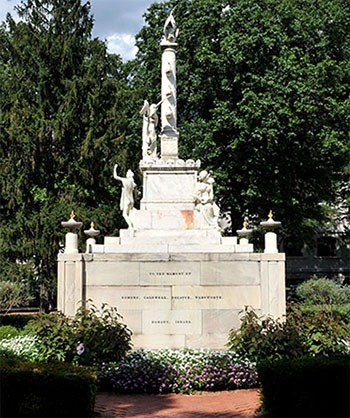 The monument's elaborate marble sculptures, intricate carvings, and classical design make it feel more like a European masterpiece than a military memorial. With symbolic references that capture the vision of a young American navy with an eagle and five symbolic figures (Fame, Glory, America, History, Commerce), it’s as inspiring as it is imposing. You’ll find it tucked inside the courtyard at the USNA Museum in Preble Hall.
Visitors should note that as of 2026, portions of the area surrounding the monument may be affected by ongoing construction and preservation work. Even so, it's absolutely worth seeking out. The Tripoli Monument remains one of the most important historical treasures at the Naval Academy and among the most significant national monuments connected to early naval history.
Related: This is Monumental: Tripoli Monument
The Mexican War Midshipmen's Monument
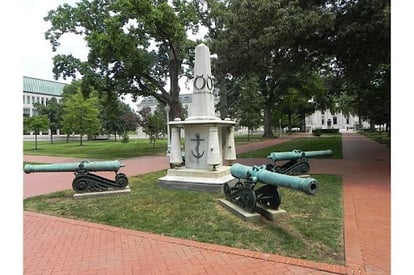 Standing near the Chapel grounds in the Quadrangle is a monument that’s been here the longest and is perhaps the best known. The Mexican War Midshipmen's Monument honors four young naval officers who lost their lives during the Mexican-American War between 1846 and 1848.
What makes this memorial especially poignant is its timing. The Naval Academy itself had only recently been established in 1845, and these young men never had a chance to attend.
Its elegant marble obelisk design, protected by four Spanish bronze 12-pounder long guns, may appear simple, but its story reflects sacrifice at the very beginning of the Academy's history. With the triangulation of Michelson and Chauvenet Halls, it’s a focal point that leads viewers to the sea. Among the many war monuments on the Yard, this one offers a particularly moving reminder of service and duty.
Related: The Mexican War Midshipmen’s Monument
Herndon Monument
No monument at the Naval Academy is more closely tied to a living tradition (or perhaps more photographed) than the Herndon Monument.
The Herndon Monument (known simply as “Herndon”) honors Commander William Lewis Herndon, who famously went down with his ship, the SS Central America, in 1857 after helping to save as many passengers as possible during a hurricane.
While the 21-foot obelisk itself stands as a tribute to courage and selflessness, today's midshipmen know it for another reason: the annual Herndon Climb.
Each spring, the “freshman” plebes work together to scale the grease-covered monument and replace the plebe "dixie cup" hat at the top with an upperclass cover. It is a raucous and revelatory event, culminating with the chant “Plebes No More!” It generally runs for a couple of hours. The event symbolizes the true end of plebe year and has become one of the Academy's most beloved traditions.
Take in its grand presence across from the Main Chapel, not far from the Zimmerman Bandstand.
Related: This is Monumental: The Herndon Monument
The Crypt of John Paul Jones
Technically, this isn't a monument at all. But no visit to the Yard is complete without descending beneath the Chapel to visit the crypt of John Paul Jones, often called the "First American Navy War Hero."
His black marble sarcophagus sits beneath the Main Chapel in a breathtaking ceremonial space lined with marble columns and naval symbolism. The deep colors evoke the sea, and the atmosphere is quiet, reverent, and unforgettable.
Jones’s remains were brought back to the U.S. after more than a century abroad, and this crypt ensures his legacy is forever preserved by the Academy. His famous declaration, "I have not yet begun to fight," helped define the fighting spirit of the U.S. Navy. Today, his resting place remains one of the most visited and meaningful locations on the Academy grounds.
You can take a USNA Historical Walking Tour to learn about the many artifacts there.
Related: Take a Tour of John Paul Jones’ Crypt
Tamanend: The God of 2.0
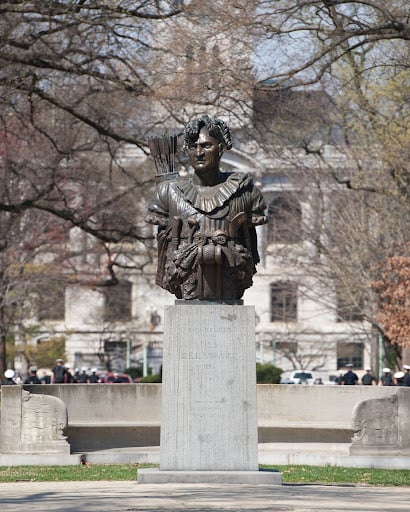
Located in T-Court, near Bancroft Hall, in the heart of the Yard, the statue of Tamanend may be one of the most beloved landmarks among midshipmen. The impressive figure represents the respected Delaware Chief Tamanend and originated as a figurehead from the USS Delaware. The current copper version contains components of the original wooden figurehead and has become an integral part of Academy folklore.
Over the years, midshipmen began tossing coins at Tamanend before exams in hopes of earning at least a 2.0 GPA. The tradition eventually earned the statue its unofficial nickname: "The God of 2.0." He is often approached before big Army-Navy football games to grant his good luck to the Midshipmen on the gridiron.
Among all the famous American monuments and memorials on the Yard, this one may inspire the most smiles.
Battle of Midway Monument
Near Bancroft Hall stands a low thick stone monument commemorating one of the most consequential naval victories in American history. The Battle of Midway Monument honors the June 1942 battle that fundamentally shifted the balance of power in the Pacific during World War II.
The monument is inscribed with the words, “Dedicated to the Preservation of the Memory of Midway where one of the most decisive naval battles in military history was fought / June 4, 1942 / The day when the American Spirit reached unparalleled heights and, in so doing, saved democracy for the western world.”
These words celebrate the courage and determination displayed by American forces during a battle that many historians consider the turning point of the Pacific campaign. For visitors interested in military history, it serves as a powerful reminder that leadership and innovation can change the course of world events.
Related: How Wade McClosky Jr. Changed History at the Battle of Midway
Navy-Marine Corps Memorial Stadium
Just beyond the Yard, the Navy-Marine Corps Memorial Stadium deserves mention.
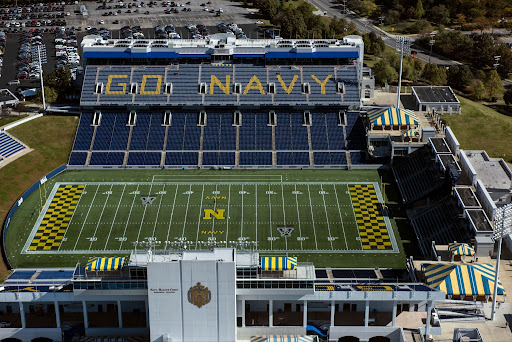
The stadium itself functions as a memorial, honoring Navy and Marine Corps personnel who have served throughout American history. Placed among the grounds, visitors will find plaques of famous battles, memorial benches, and tributes dedicated to service members and Academy graduates. Together, these memorials reinforce the Academy's mission of preparing leaders who will continue serving around the globe.
Why These Monuments Matter
The monuments of the Naval Academy bring history to life, telling stories and preserving traditions. They connect today's Brigade to the generations of officers who served before them. And perhaps most importantly, they remind visitors the Academy is both a place where history is remembered and a place where history continues to be made.
While pictures and descriptions give you a sense of the significance these monuments hold, there’s no substitute for experiencing them in person. Standing before these tributes to heroism and sacrifice brings the Academy’s history to life in a way no textbook or article ever could. In fact, many USNA tours can further enhance your experience with the stories behind the scenes.
When you visit the Yard, you're not only exploring some of the most fascinating monuments commemorating naval history, you're also helping to support today's midshipmen.
Proceeds from USNA tours, dining on the Yard, and shopping at Academy stores or Navyonline.com help fund extracurricular programs that enrich the Brigade's experience, including cultural arts, music, theater, and club sports.
So the next time you're in Annapolis, take a little extra time to wander the Yard. Some of the most memorable stories you'll encounter aren't found in exhibits or museums. They're carved into the monuments standing right in front of you.